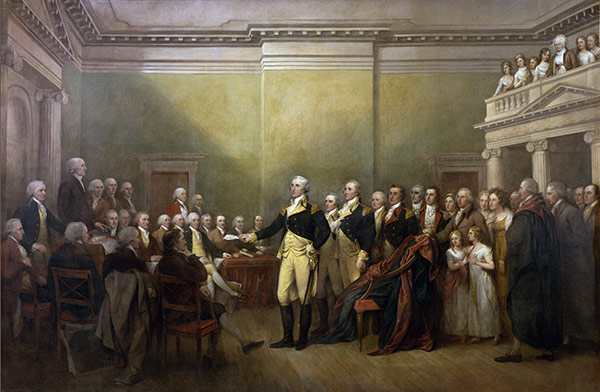
Abiel Foster was born in Andover, Massachusetts, on Aug. 8, 1735. His father was Captain Asa Foster, an early owner of substantial land holdings in Canterbury. Abiel came to Canterbury after graduation from Harvard in 1756. Studying for the ministry, he was called to Canterbury soon after his ordination. He remained a minister here until he stepped down in January of 1779. He stayed in Canterbury, however, and took no other pastorate.
Abiel Foster was an ardent patriot through the American Revolution. He was chosen to be a deputy to the Provincial Congress called to meet in Exeter in 1775. For the years 1779, 1781 and 1782, he represented Canterbury in the General Court, and in 1783, 1784 and 1785, he was chosen to participate in the Continental Congress, assembled to write a charter for the new nation after it achieved its independence from Great Britain.
After adoption of the Federal Constitution, Foster was elected to the U.S. House of Representatives in the first, fourth, fifth, sixth and seventh Congresses as a Federalist, retiring from the last in 1803 on account of ill health. He also served several terms in the N.H. Senate from 1791 to 1794, in the years in between his service to the U.S. House, and he was president of that body in 1793. He was also a member of one of the conventions called to form a constitution for the state of New Hampshire. For four years, he was also a judge for the Court of Common Pleas in Rockingham County.
Abiel Foster was present at Annapolis when President Washington resigned his commission to Congress in December, 1783, the only member from New Hampshire, and he is shown in John Trumbull’s painting of this event, which hangs in the rotunda of the Capitol in Washington, D.C. He is seated directly in front of Washington with his arm on the back of a chair. He must have had a good personal relationship with Washington since Washington gave him a miniature portrait of himself painted by a European artist.
In the words of Canterbury’s historian, James Otis Lyford, upon whose work this essay is largely attributable, “The public career of Abiel Foster was the longest and most distinguished that any citizen of Canterbury ever obtained.” Lyford wrote those words in 1912. Over 100 years later, they still hold true. There is no close second.
~ Harry Kinter, Canterbury Historical Society Trustee
 Canterbury NH Community Newsletter